

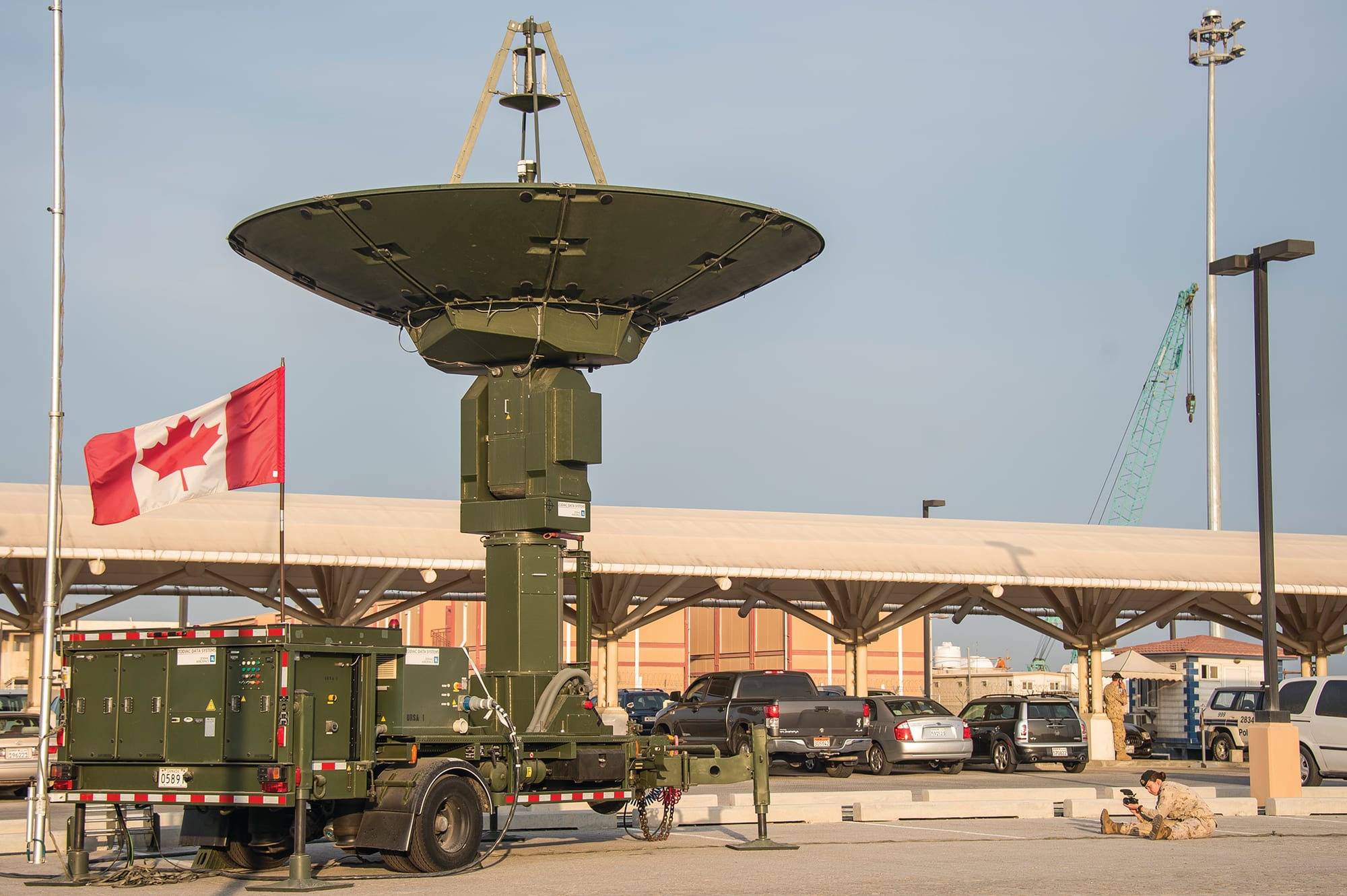
Photo: Master Corporal Mathieu Gaudreault, Canadian Forces Combat Camera IS04-2017-0001-004
A soldier from Canadian Forces Combat Camera films the movements of the Unclassified Remote-Sensing Situational Awareness Satellite (URSA) in Manama, Bahrain on January 26, 2017.
Lidia Korczynska is the director of the DND/CAF AI Centre and Data Policy and Governance. She previously worked in Parliamentary and Regulatory Affairs at the Canada Border Services Agency.
The Department of National Defence (DND) and the Canadian Armed Forces (CAF) are entering a decisive phase in the journey to operationalize artificial intelligence (AI). AI is transforming every aspect of our lives, and it is central to modern defence. AI underpins platforms like the F-35 and the River-class destroyer, and it is critical in cyberwarfare, disinformation, and autonomous weapons. AI also presents a unique opportunity for Defence to transform itself, but only if we are willing to seize this moment. The flip side of opportunity is risk. And the biggest risk we can take is to maintain the status quo.
To keep pace with allies and adversaries, Canada must transform Defence AI from fragmented experimentation into an integrated and mission-ready capability. We will do this by aligning talent, data infrastructure, procurement, and partnerships across Defence to be AI-enabled by 2030. To accomplish that, we are charting a practical path forward—each L1 is responsible for its AI systems, while the AI centre establishes clear enterprise guardrails, shared data and compute foundations, and procurement pathways allowing rapid piloting and scaling. We are also sustaining engagement with industry, academia, and allies to accelerate delivery, strengthen options for use cases, and ensure that our investments contribute to NATO outcomes.
AI and ROI
A recent MIT report cautioned that 95% of generative AI pilots fail due to poor integration and internal builds.Footnote1 For Defence, AI presents an opportunity to leapfrog some of our technical debt, but only if the Defence Team is willing to do the hard work where it matters. Breaking down legacy silos, transparency and collaboration are not just sound leadership practices––from my perspective, they will make or break our digital transformation efforts. We must be willing to do the painful work of identifying business rules that are overly burdensome or outdated, be courageous enough to work collaboratively, and be humble enough to know that none of us can succeed alone.
Enterprise-wide transformation, which takes years, should also be broken down into shorter pilots and sprints, as technology changes quickly and implementing new digital capabilities may reveal other capability gaps. DND/CAF can implement change more effectively by designing enterprise AI capabilities that start small but are built to scale across the organization. This approach allows Defence to rapidly learn from pilots, scale successful solutions, and continuously adapt to evolving operational and business demands. In a similar vein, we should move away from viewing digital capabilities as merely an enabler and instead position digital as the core of operations, with human capital as the driving force behind it. Defence can build this deliberate and measured approach to innovation through the Defence Industrial Strategy and other collaborative frameworks.
The Vision for an AI-enabled DND/CAF
The DND/CAF AI Strategy commits Defence to becoming an AI-enabled organization by 2030,Footnote2 using responsible AI in ways that strengthen operational outcomes and modernize corporate functions while maintaining trust. It emphasizes practical application over experimentation, ensuring that AI solutions are developed with and for Defence personnel to address real mission and business needs. This vision underlines DND/CAF’s commitment to interoperability with allies and an innovation-ready culture.
To achieve this vision, the DND/CAF AI strategy outlines five main lines of effort that will translate this vision into a decision advantage. These include fielding and employing AI capabilities; driving change management to integrate AI into real workflows; embedding ethics, safety, and trust across the AI lifecycle; building talent and training for an AI‑ready workforce; and deepening partnerships with allies, industry, and academia. Together, these aim to deliver and operationalize AI capabilities for CAF personnel.
AI impacts all layers of the digital foundation, from user devices to networking, hosting, and cybersecurity. To capitalize on the opportunities that AI presents, Defence requires quality data, interoperable systems, DevOps orchestration, super-compute platforms and advanced technical skills and partnerships. However, by their nature, Defence organizations are highly distributed with many autonomous parts. This makes coordination and integration difficult and complex.
There are a number of challenges that may prevent us from becoming AI-enabled by 2030. These include fragmented efforts and shadow IT; talent gaps; missing infrastructure; lack of data integration for next-generation platforms and our late start compared to allies and adversaries.
As a public sector organization, National Defence and the Canadian Armed Forces are competing for the same talent as the private sector, and for the same technological innovation as our allies and adversaries. The federal ecosystem also presents a tangled web of matrixed responsibilities, overlapping mandates and at times contradictory objectives.
Luckily, Defence is not starting from scratch. Our civilian AI ecosystem is world-class, anchored by the three Canadian national AI institutes Mila, Vector, and Amiias identified in the Pan-Canadian AI Strategy.Footnote3 Internationally, our closest allies have shown what is possible: the United Kingdom’s Defence AI Centre has demonstrated how a single hub, supported by an AI Safety Institute, formal AI standards, and transparent playbooks, can unify fragmented efforts, accelerate procurement, and build trust through responsible deployment.Footnote4 Its AI Model Arena evaluates multiple AI systems against defence scenarios, providing objective data that reduces risks and informs evidence-based procurement. Meanwhile, DAIC brings subject matter experts and academics into the conversation, accelerating innovation while embedding ethical and operational standards at the outset. Canada must now learn from these initiatives and Canadianize these lessons, consolidating our activity, preventing duplication, and demonstrating measurable contributions to NATO’s defence investment targets.
Fight from Prototype
The DND/CAF AI Centre enables mission-ready capabilities through a federated or franchise model, where each part of the organization retains ownership and accountability for their AI systems, but they operate within clear enterprise guardrails. Beginning in 2025–26, the AI Centre is moving beyond drafting policies to implementing them, proving their value through operational pilots, and scaling adoption across Defence.Footnote5
We work with the CAF to identify AI needs or capability gaps and identify potential solutions, including piloting new capabilities with a view to understanding how they perform in operational scenarios. The AI Centre also works in partnership with Defence Research and Development Canada and academia to bring research and development to production so that innovative AI capabilities can be tested by the CAF.
In 2026/27, pilots will mature into capabilities. This means that sovereign AI pilots will be running and tested across CAF operational functions, visibly demonstrating that Canada is not reliant on foreign solutions for its most sensitive applications. Alongside these pilots, all available procurement pathways will be pursued, ensuring that promising projects can transition to scale. New solutions using emerging AI technologies will have been introduced, and the year will close with a formal lessons-learned report—evidence that our frameworks have been tested in practice and are ready to guide future growth.
If these goals are not achieved on the anticipated timelines, we risk lagging in AI adoption, potentially eroding operational advantage and interoperability with key allies. To mitigate this risk, L1s must embed flexible metrics and maturity assessments that enable course correction and continuous learning from experience.
Within the Digital Services Group, the AI Centre builds connections between the CAF and industry, academia, and allies to deploy mission-ready sovereign AI capabilities. These efforts include the establishment of a robust digital foundation that supports on-premises and cloud environments across unclassified and classified domains, enabling joint operations through unified enterprise cloud services, data, compute, cybersecurity, and application development. Looking ahead, the AI Centre will be an integral part of supporting other whole-of-government efforts to create a Defence-Industrial base and modernize defence procurement.
The strategic intent for the DND/CAF AI Centre is to be a cohering force that supports CAF L1s. The AI Centre will enable secure deployment paths, support AI governance, temporarily embed AI-skilled personnel within each L1, and provide data, tailored advice and support. In turn, L1s will benefit from engaging with the AI Centre before developing AI independently; we may already have a deployed model for use!Footnote6 In order to prepare for AI, L1s also need to collaborate on platform design and enterprise tools and do the work to ensure that data is well-governed, usable and interoperable, while adhering to NATO standards.
This cycle—pilot, evaluate, scale—is what turns frameworks from paper to operational doctrine.
Engagement with Industry and Academia
Defence cannot innovate in isolation. The AI Centre is undertaking a comprehensive mapping of industry and academic partners and creating an engagement plan to ensure that our interactions are structured and targeted. In parallel, the AI Centre is working in partnership with Carleton University to organize the first-ever AI in Defence Conference, which will convene Defence, industry, academia, and trusted partners to advance DND/CAF’s responsible adoption of AI.Footnote7 This conference will allow DND/CAF to align with industry partners on a five-year roadmap for AI and data capabilities.
Engagements like the upcoming AI in Defence Conference early in the year prove that Defence is connected to the broader ecosystem. Sustained partnerships will show that Defence is not simply a consumer of innovation but a contributor to Canada’s wider AI success story.
Together, the AI Centre must work to identify the AI talent in our organizations and empower them to help us. From a recruitment and retention standpoint, we need to explore every option to bring in the best and brightest. We will all benefit from building collaborative partnerships, and, most importantly, we must all take a hard look at our business processes and ask how we might do things differently for the AI era.
Enabling procurement and NATO Contributions
Underlying every strand of this strategy is procurement. Without pathways tailored to AI, promising pilots will remain trapped as experiments. In 2026/27, the AI Centre will enable new digital procurement pathways to create a continuous cycle of small-scale pilots to quickly deploy and test new technologies. CAF members will be able to collaborate with industry to co-develop innovative technologies with end-users and acquire those that prove effective in piloting. We will also manage a vendor repository to prevent duplication and inform different teams on what has been done and what teams could inform on lessons learned along with best practices for like-minded projects. These near-term steps will build momentum, with classification-ready lots and dynamic purchasing.
At the same time, we will ensure every AI investment is accurately tracked. Each project will be tagged to NATO capability codes,Footnote8 ensuring that Canada’s AI investments are recognized as defence contributions. This means that we will be able to report not only the number of projects underway but the proportion of AI investment that qualifies under NATO’s defence investment categories—a visible demonstration of Canada’s seriousness about emerging technology.
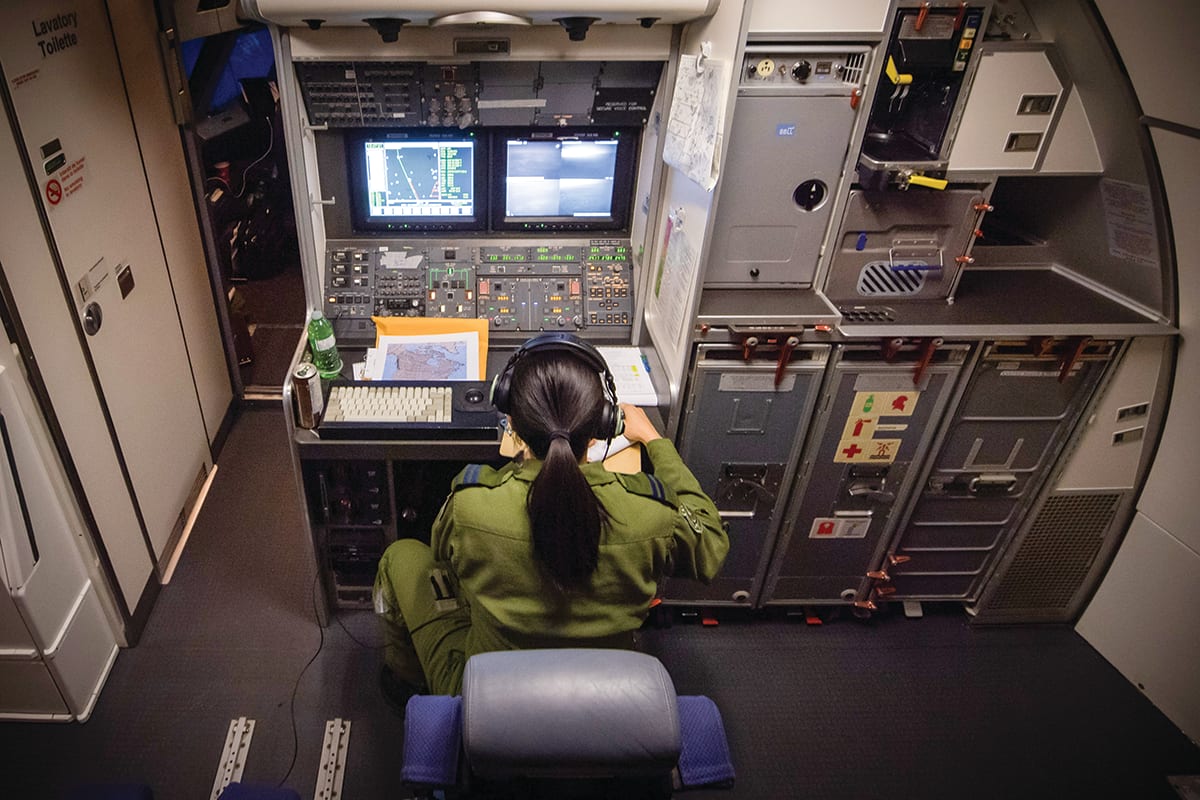
Photo: MCpl PJ Letourneau, Canadian Forces Combat Camera
An officer from 437 Transport Squadron in Trenton, coordinates the air-to-air refueling operations over the Canadian Arctic between a CC-150 Polaris Airbus and two CF-18 Hornets from 401 Tactical Fighter Squadron in Cold Lake during the NORAD Exercise AMALGAM DART 21-2, on March 23, 2021.
Coordination Across the Federal Ecosystem
Across the federal ecosystem, success will require an appetite for smart risk-taking and regulatory sandboxes to allow experimentation, and industry needs more certainty that there is a future with Defence. None of this will happen overnight; it will require incremental progress with lessons learned along the way.
Our sustained momentum has laid a strong foundation for success; the priority now is to provide clear, accessible pathways and a coherent vision that enables seamless engagement by CAF personnel and industry. Achieving this will require a laser‑sharp focus and overcoming key barriers, including slow and complex procurement processes, and inconsistent data and digital readiness. We can surmount these challenges through clear guidance and enterprise coordination.
Conclusion
The coming year promises to be very exciting as the AI Centre moves from developing framework and policies to implementing them. Governance and responsible AI tools will be embedded across L1s, sovereign pilots will be underway, procurement pathways will be enabled, industry and academia will be engaged, and our workforce will be ready. Canada will be able to show NATO and our allies that we are not just talking about AI in Defence—we are adopting it responsibly, at scale, and with impact.
The UK has shown what is possible when ambition meets structure. Canada is now ready to catch up, with a plan that is distinctly ours: rooted in sovereignty, aligned with NATO, and focused on delivering trusted capability to the war fighter.